As
automakers aim to keep sales ahead of 2015's record-setting pace,
they're pulling out all the stops to draw in buyers. Virtual reality may
be next in their bag of tricks.
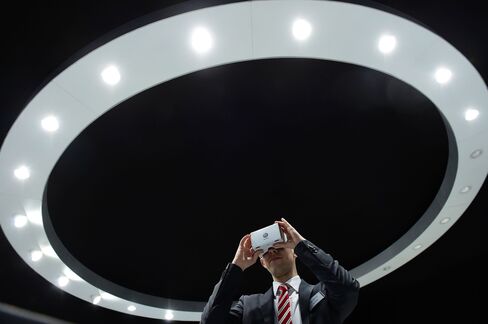
Volkswagen AG's Audi plans to
roll out Oculus Rift headsets in a number of dealerships by the end of
this year. Johan de Nysschen, president of General Motors Co.'s
Cadillac, in February encouraged some of the company's lowest-volume
outlets to go virtual. With dealers from Brazil to Berlin already
experimenting with virtual reality, automakers see twin benefits of the
technology: enhance the customer experience while also shaving off some
of the $2.75 billion U.S. dealers spend annually on interest to keep new
vehicles on their lots.
"You're wearing the glasses and you
really think you're in the car," said Marcus Kuehne, Audi's
virtual-reality project lead. The brand already allows customers to
pre-equip cars in a handful of highly digitized urban dealerships
and sees virtual reality as the next step in letting shoppers see what
they want to buy. "You get a good feeling for the size -- do the rims
fit to the body of the car, do the colors inside the car fit well
together?" he said. "You can judge this much better through this
technology than on a screen."
Letting
customers manipulate models, color schemes and features in a virtual
environment is automakers' latest tool to distinguish themselves in a
slower-growing yet very profitable market. April sales announced on
Tuesday will probably show gains for most of the biggest U.S. and
Japanese automakers, as the annualized selling rate, adjusted for
seasonal trends, rises to 17.5 million, according to a Bloomberg survey.
The pace and the month's total are projected to set April records.
'Robust' Industry
"Top-line
performance of the industry remains robust -- retail demand is strong,
transaction prices are at record levels and consumers will spend more on
new vehicles than in any other April on record," John Humphrey, senior
vice president of the global automotive practice at J.D. Power, said in a
statement. "The slowing rate of growth, shift in consumer demand away
from cars and toward SUVs, and elevated fleet volumes pose significant
challenges to manufacturers as they compete in the marketplace."
General
Motors
expects industrywide sales to rise 5 percent and a seasonally
adjusted annualized pace of 17.5 million vehicles or higher, said Kurt
McNeil, vice president of U.S. sales. While the Ford and others have
increased sales to fleet customers so far this year, GM has reduced
them. As a result, the Detroit-based automaker delivered record North
American profits in the first quarter, even as U.S. sales slipped by a
few hundred. For April, analysts project a 1.7 percent decline for GM.
"The
economic fundamentals are there," McNeil said. "Interest rates are
still low and gasoline prices may be the lowest this summer since 2005."
Nissan
Motor Co.'s sales may rise 11 percent, the biggest increase projected
by the analyst estimates, followed closely by Honda Motor Co., seen
gaining 10 percent. Combined sales of Volkswagen's VW and Audi brands
may fall 1.5 percent as Europe's largest automaker tries to overcome consumer distrust since its diesel-emissions cheating scandal that may cost about $18.2 bilion.
Enticing Visitors
Automakers
already have some experience using virtual reality to promote their
vehicles. In 2014, Fiat Chrysler Automobiles NV touted the 2015 Chrysler
200 sedan by giving viewers a virtual reality tour of its factory.
Volvo Car Group, owned by Zhejiang Geely Holding Group Co., used the
technology to introduce its XC90 SUV to consumers before it became
available in U.S. dealerships less than a year ago. And at this spring's
New York auto show, Toyota Motor Corp. enticed visitors by letting them
use headsets that demonstrated its cars' safety features,
including pedestrian detection.
Virtual reality has blossomed from
a far-out concept to an almost-practical form of delivering
entertainment and information thanks to improvements in image quality,
computer bandwidth, and investment by companies like Facebook
Inc. Oculus VR Inc., which was bought by Facebook for $2 billion in
2014, launched its virtual reality headset for $599, compared with HTC
Corp.'s HTC Vive, priced at $799.
While
the gaming industry will likely account for most of virtual reality's
near-term use, Bloomberg Intelligence analyst Jitendra Waral sees it
becoming a core part of the consumer experience for a number of
industries, including autos, health care and tourism in the next four to
five years. Sales tied to the headsets may top $1 billion this year and
reach $21 billion by 2020, Waral estimates.
"What companies are
doing is they're creating these consumer touch points to differentiate
themselves and be more competitive in terms of the experience," he said
in a phone interview. "It's completely different than the way you do
things right now, so that novelty is what grabs the attention."