Friday, 5 April 2019

Canada’s push for ZEVs is real

The federal budget 2019, announced in February by the Minister of Finance Bill Morneau reveals a strong push towards a more electrified future in Canada.
On March 29, the Government of Canada delved into a deeper discussion about their plan to build a “clean economy,” indicating that the budget is making significant investments towards that goal by, for example, expanding the network of zero-emission vehicle charging and refuelling stations. And also by creating new incentives for both consumers and businesses to purchase ZEVs.
“Starting this year, it is no longer free to pollute anywhere in Canada. Our clean growth and climate action plan is expected to result in the biggest drop in carbon pollution in the history of Canada’s emissions reporting — while creating more good, well-paying jobs in the clean economy and making life more affordable for Canadians,” said Catherine McKenna, Minister of Environment and Climate Change.
The budget also allocates funds to lowering the cost of energy by boosting energy efficiency in residential, commercial and multi-unit buildings.
New infrastructure is also meant to create cleaner communities. This goal will be topped-up through a major municipal infrastructure investment to help communities fund their own infrastructure projects.
The government also aims to work with provinces and territories to develop a framework for a more electric future that not only focuses on urban areas, but rural and remote communities as well.
Another goal is to phase out coal-fired electricity by 2030, and funds in the budget aim to help these workers and communities “find and act on new opportunities” through skills training and business diversification.
The Government of Canada wants to reach a new-vehicle sales target of 100 per cent ZEVs by 2040. The goal is to reach 10 per cent sales by 2025, and 30 per cent sales by 2030. The federal budget clearly indicates that this is an important target that the government will strive to reach.

By: www.canadianautodealer.ca

Thursday, 4 April 2019

This is the No. 1 car among millennials, according to a new study of insurance data

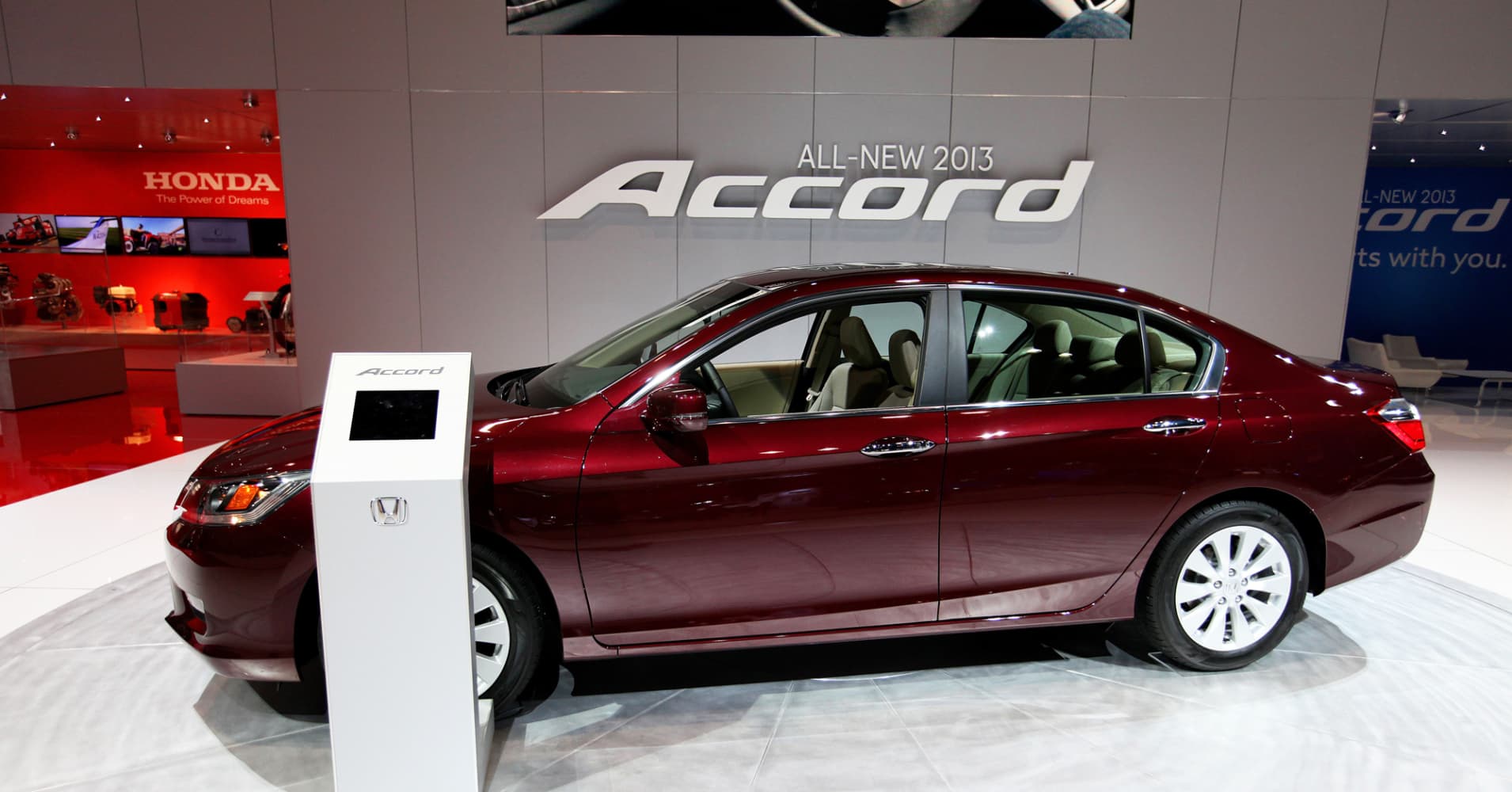
The 2013 Honda Accord, at the Chicago Auto Show, February, 2013.
Young people are often said to splurge on indulgences - avocado toast, for example, or daily coffee. When it comes to the cars they drive, however, that doesn't seem to hold true.
Insurance comparison website QuoteWizard, which is owned by LendingTree, dug into its 2018 insurance quote data for drivers aged 22 to 37 "to find the most common vehicles driven by millennials."
The answer: More affordable ones. The No. 1 car among millennials, they found, was the Honda Accord.
The data did not make clear whether young people were buying these cars new or used, or getting them as gifts. Still, it was striking to QuoteWizard that the most popular choices among millennials were "among the cheaper cars on the road."
Of the top 10, eight are small to mid-sized cars, says QuoteWizard, which tend to cost less. The data shows that millennials "tend to drive cheaper sedans" instead of the SUVs and trucks favored by older generations, the site concludes.
Here are the top 10 most popular car brands among millennials and their average MSRPs:

Honda Accord

Average MSRP: $23,720

Nissan Altima

Average MSRP: $23,900
Honda Civic
Average MSRP: $19,450

Toyota Camry

Average MSRP: $23,945

Hyundai Sonata

Average MSRP: $22,500

Chevrolet Impala

Average MSRP: $28,020

Ford F-150

Average MSRP: $28,155

Toyota Corolla

Average MSRP: $18,700

Ford Focus

Average MSRP: $17,950

Jeep Grand Cherokee

Average MSRP: $31,945
Millennials may be spending less on cars because they have less money to spend. While "millennials are making more than ever for the 22 to 37 age group," QuoteWizard cites, "they still earn significantly less than their Gen-X and baby boomer counterparts." Plus, they must often contend with the cost of housing and student loans.
And finances aren't everything. "Earning less money and being buried by debt is a huge factor," says QuoteWizard, but "this doesn't paint the entire picture of why millennials prefer cheaper cars. Urbanization trends show that millennials are happier living in big cities. They're also moving to cities at a higher rate in the last nine years than they did in the 2000s."
Also, "living in urban cities gives millennials more options like public transit [and] ride-sharing services. All these alternative options create less of a need for cars, let alone expensive ones."

Stick with your car for 'as long as you can,' experts say

If you are in the market for a car, experts advise to get only what you can afford and not to buy new.
While it's tempting to splurge, best-selling author of "The Automatic Millionaire" David Bach has said that can be the "single worst financial decision millennials will ever make."
"Nothing you will do in your lifetime, realistically, will waste more money than buying a new car," he told CNBC Make It.
In a blog post, best-selling author of "Women and Money" Suze Orman suggested you fall in love not with an expensive car but with a retirement or savings account, or a home: "Those are assets that, over time, may increase in value. A car will never increase in value. It is a depreciating asset that loses 20 percent of its value in the first year."
If you already have an auto loan, look into some refinancing options, especially if you have good credit. A "prime" or "super prime" score could help you with financing. And if you're still working on your score, stick with your current car for "as long as you can," wrote Orman.
The bottom line is, the less money you spend on a car, the more you can put toward other important priorities. And that's a good step toward building financial security.

By: www.cnbc.com

Friday, 29 March 2019

Jaguar Land Rover hopes its future vehicles can help stop the spread of colds and the flu

Can a car help combat the spread of colds and the flu?
That's what Jaguar Land Rover is looking to find out with its future models.
The British company has announced Wednesday that "the car of the future could help win the battle against superbugs."
The cure?
The luxury auto manufacturer said in a statement it is looking to use a type of ultraviolet light technology (UV-C) like what the medical industry has been using for more than 70 years.
"The average motorist spends as much as 300 hours per year behind the wheel," said Dr. Steve Iley, Jaguar Land Rover chief medical officer, in the statement. "There is a clear opportunity to better utilize cars for administering preventative health care."
This technology already is widely used to disinfect water, filter air and sterilize surfaces. Jaguar Land Rover believes it can be integrated into its cars to stop bacteria from surviving in the cars cabin.
According to the company, recent medical trials of the technology suggest the technology can cut four major drug-resistant superbugs, including MRSA, by up to 30 percent.
"In the colder months infections are spread more easily, it's reassuring to know that in your car at least, you can be confident that harmful pathogens are being neutralized," Iley said.
The company says it's exploring "a wide range of driver and passenger wellbeing features as it works towards a self-driving future."
While Iley said he believes cars can play "a part in preventative healthcare in an age of shared mobility," a date for when the technology will be integrated in the cars was not included in the announcement.
By: www.usatoday.com

Wednesday, 27 March 2019

Volvo CEO predicts huge increase in plug-in hybrid sales

Volvo expects plug-in hybrid versions of models such as the S90 (shown) to soon account for up to 25 percent of global sales.
Volvo expects a huge increase in sales of its plug-in hybrid vehicles by year-end after underestimating demand for its growing family of electrified models.
"By the end of the year we should be up to 20 to 25 percent," Volvo CEO Hakan Samuelsson said during a roundtable discussion with journalists this week.
In the model lines where plug-in hybrids are currently available, this includes the XC90 and XC60 SUVs and the V90 and V60 station wagons, those variants account for about 10 percent to 15 percent of Volvo's global sales.
Volvo didn't have enough batteries, electric motors and the other key components needed to make its plug-in hybrids, Samuelsson said.
"We are not happy because we could sell more [plug-in hybrids]," he said. "We underestimated the demand."
Tripling capacity
Samuelsson said Volvo is currently "ramping up all the components" it needs to produce its plug-in hybrids -- as well as its recently added family of mild hybrid powertrains.

"We are tripling the capacity from what we had about a year ago to where we will be at the end of this year," he said.

Volvo will introduce a range of mild hybrids this year, starting with diesel and gasoline versions on the XC90 and XC60. The mild hybrids, which will wear Volvo's new B badge, will be equipped with Volvo's brake-­by-­wire energy recovery system.

Despite the supply bottleneck Volvo sold 26,800 plug-in hybrids in Europe last year, up from 16,000 in 2017, according to figures from market analyst JATO Dynamics. By 2021 Volvo expects that a quarter of the vehicles it produces worldwide will be plug-in hybrids. The other model lines that offer the powertrain are the S90 and S60 sedans.7
By: www.autonews.com

Friday, 22 March 2019

Porsche adds sporty 'coupe' to Cayenne lineup

Porsche aims to reignite sales of the popular Cayenne crossover with a sportier coupe variant that will square off against the Mercedes-Benz GLE Coupe and the BMW X6.
The German automaker hopes to lure the sport-ute crowd and boost profitability with what it refers to as the "sportiest-looking model in the segment."
Porsche Chairman Oliver Blume, in a statement Thursday, calls the Cayenne Coupe "more progressive, athletic, and emotional."
The Cayenne Coupe is expected in U.S. showrooms this fall. It will start at $76,550, including $1,250 for shipping. The Cayenne Turbo Coupe will start at $131,350, including shipping. Both Cayenne Coupe models are priced higher than the standard Cayenne.
The Cayenne Coupe is a competitive response to similar coupe-crossovers from Audi, BMW, and Mercedes-Benz. BMW created the coupe-crossover segment with the X6.
"These models have proven to be particularly popular in emerging luxury markets like China and the Middle East," said AutoPacific analyst Ed Kim. "Porsche clearly hopes to gain volume by introducing a model in a growing segment."
The midsize Cayenne was Porsche's second best-selling model in the U.S. last year — behind the compact Macan — with sales 10,733 units. But U.S. sales of the Cayenne have dropped off since peaking at 18,507 in 2013, and Porsche faces more competition from new SUVs and crossovers from BMW, Audi, Mercedes, Jaguar, Land Rover and others.
The Cayenne Coupe features sharper lines with a redesigned rear section, adaptive rear spoiler, individual rear seats and either a panoramic fixed glass roof fitted as standard or an optional carbon fiber roof. The rear doors and quarter panels have been redesigned to broaden the shoulders of the vehicle. The license plate bracket is now part of the bumper and makes the vehicle look like it sits lower to the ground.
The Cayenne Coupe will be available with two high-performance engines. The standard model will feature a 3.0-liter mono-turbo V-6 engine capable of generating 335 hp and sprinting from 0-60 mph in 5.7 seconds.
The top-of-the-range Cayenne Turbo Coupe is equipped with a 4.0-liter twin-turbo V-8, capable of 541 hp and a 0-to-60 mph acceleration time of 3.7 seconds.

By: www.autonews.com

Friday, 15 March 2019

Nissan Tests Invisible To Visible Tech That Makes Real Life Like A Video Game


Nissan wants to merge the real and digital worlds. The Japanese automaker is testing what it calls "invisible-to-visible" (I2V) tech, which uses digital projections that, among other things, allow drivers to converse with virtual avatars. The tech was unveiled at CES 2019 in January, but Nissan is just now giving it a real-world road test.
I2V connects users to what Nissan calls the "Metaverse." If that sounds like a Ready Player One ripoff to you, you're not too far off. Nissan wants to use I2V to project digital avatars of people into cars, so vehicle occupants can have a conversation with someone who isn't actually there. So you could, for example, get a lesson from a driving coach who isn't even in the same zip code as the racetrack. Nissan also believes I2V can be used to help drivers "see the invisible," such as what's around a corner or too far down the road to be seen by the naked eye. Other companies have also proposed using similar tech for in-car advertisements.
At CES, Nissan demonstrated I2V in a simulated car interior in its booth on the show floor. But now, Nissan is conducting tests in a moving vehicle to see how people react. The test vehicle is a modified Nissan NV350 van, a model that isn't sold in the United States. Nissan teamed up with Docomo to equip the van with a 5G connection, allowing the onboard systems to transmit the massive amount of data required to make I2V work.
Nissan has not discussed specific plans to use I2V in a production car. That's not too surprising, as the tech likely has a long way to go. Lifelike holographic images and digital projections have yet to be perfected in any form, let alone one that will work reliably in a moving vehicle. Nissan will also have to make sure that the "Metaverse" doesn't become too distracting. The digital projections could very well lead to information overload, although that won't be a problem if self-driving cars ever become mainstream.
By: www.thedrive.com

Thursday, 14 March 2019

VOLKSWAGEN GROUP NOW PLANNING TO LAUNCH 70 ELECTRIC CARS BY 2028, UP FROM 50

German automaker isn't backing down in its commitment to electric vehicles, and says it will be carbon neutral by 2050.
Volkswagen Group's leadership has announced a ramping up of its already ambitious electric vehicle plans at its 2019 annual press conference.
The German automaker now plans to launch 70 new electric cars by 2028, up from the 50 it had previously committed to.
It now predicts it will make 22 million electric vehicles in the next decade, up from the previous forecast of 15 million.
If all goes according to plan, 40 per cent of the group's sales will be electric by 2030.
Production of the company's first mass-market pure electric vehicles begins this year, when the Porsche Taycan and the Audi E-Tron crossover start trundling out the factory gate.
Volkswagen says there are 20,000 reservations for both of these initial models.
Next year, the company will be sales of the first vehicles based on its new MEB electric car architecture, starting with the Volkswagen ID hatch.
It will be followed up with production versions of the Volkswagen ID Crozz crossover, ID Buzz kombi van, ID Vizzion sedan, Seat el-Born hatch, and Skoda Vision E crossover.

The company estimates it will spend €30 billion ($48 billion) by 2023 on its electric vehicle roll out.
In addition to ramping up its EV efforts, the company has also pledged to be fully CO2 neutral by 2050 "in all areas from fleet to production to administration".
The automaker will begin first by reducing its CO2 output, switching to renewable energy sources, and compensating for unavoidable greenhouse gas emissions. The company says it has also begun to make changes to its supply chain, with particular effort being put into steel and aluminium production.
Interim targets include halving CO2 emissions from its own factories, compared to 2010 levels, by 2025, and converting its coal-fired power plant in Wolfsburg to natural gas.
By: caradvice.com.au