Federal government says Canada's emission standards need to strengthen as Trump moves to ease rules
OTTAWA-As Donald Trump's administration moves toward easing U.S. fuel emission standards for vehicles, the Liberal government says Canada's standards need to become "stronger," and it will conduct its own assessment after the American review.
Reports emerged this week indicating Trump is set to introduce new rules for auto emissions.
In Canada, officials in Environment Minister Catherine McKenna's office say they're watching the U.S. developments closely, but they add that Canada's standards need to become stronger over time, because transportation accounts for nearly one-quarter of Canada's greenhouse gas pollution. (PATRICK DOYLE / THE CANADIAN PRESS FILE PHOTO)
The current rules were adopted jointly by former prime minister Stephen Harper and former U.S. president Barack Obama in 2014 with the aim of increasing fuel efficiency for vehicles sold between 2022 and 2025 and reducing greenhouse gas from cars and light trucks.
Trump is also expected to challenge California on its ability to independently set regulatory standards.
In Canada, officials in Environment Minister Catherine McKenna's office say they're watching the U.S. developments closely, but they add that Canada's standards need to become stronger over time, because transportation accounts for nearly one-quarter of Canada's greenhouse gas pollution.
McKenna and California Gov. Jerry Brown have discussed "our shared goal to fight climate change and promote clean transportation," said Caroline Theriault, a spokeswoman for the minister.
Christopher Sands, a senior research professor and director of the Centre for Canadian Studies at Johns Hopkins University, called the situation a "fascinating" case because it's an example of U.S.-Canada regulatory co-operation that saw Obama decide on increasing standards and Harper agreeing. But now that co-operation is under threat.
Harper had argued it didn't make sense for the Canadian economy to get ahead of the U.S. economy on environment policy because Canada would bear additional costs, making it less competitive.
Even if the U.S. eyes changes to emission standards, it doesn't necessarily affect Canada's rules, Sands said, but Canada will have to consider a similar move because the auto industry would prefer not to operate under two sets of regulations.
Dan Woynillowicz, policy director for the advocacy group Clean Energy Canada, said the auto sector on both sides of the border will be in for a fairly long period of uncertainty.
IN THIS WACKY new world of bike shares, electric scooters, OneWheels, and transit apps, automotive companies aren't quite famous for their inspired, innovative business moves. But today, BMW is sending up the industry's latest trial balloon. And it's headed straight for airspace currently occupied by Uber and Lyft.
Starting today, the automaker's ReachNow arm, which offers a car-sharing service in a handful of cities across the US, also has a ride-hailing service. If you happen to live in Seattle, you and your loved ones can still rent from a roving fleet of hundreds of BMW (including the electric i3) and MINI cars, scattered throughout the city. But you'll also be able to hail a ride, or schedule one up to seven days in advance, for a trip with a professional driver, à la Uber Black or Lyft Lux.
Call it BMW's "throw everything at the wall and observe the sticky things" strategy. Or a groundbreaking, iterative approach to mobility. (Guess which one BMW likes.) Or a market research gambit.
"We truly believe in owning the IP and understanding the data and analytics," says Simon Broesamle, ReachNow's chief customer officer, explaining why BMW built its own ride-hailing service instead of partnering with an existing company. He says the service should provide valuable insight into when people want to rent cars and when they want to rent drivers.
BMW ReachNow users who don't feel like driving themselves can now schedule rides with professional employees of third party transportation companies, up to seven days in advance.
BMW
"The earlier we know about it, the earlier we can inform people who are working these products in the long-term," Broesamle says. And the earlier they can work on positioning BMW to survive into the next century, when urban car ownership should be less important.
"Less" is the operative word there. There has been much hemming and hawing about the death of the personal vehicle-fewer Americans are getting drivers licenses, and some in the densest cities are forgoing car ownership altogether. But for BMW, ReachNow is less about replacing all personal vehicles than allowing families to pare down their collections. Indeed, the company says it has had most success with urban families, who increasingly lean on ride-hailing services and transportation alternatives when their one car is busy. (ReachNow says it picked Seattle for its ride-hail rollout because the populace is so tech-friendly. It tested the service in beta last summer.)
But what sorts of supplementary services does a busy single-car family need? Through ReachNow, the company hopes find data that will help it parse nuanced answers to those questions.
For that reason, this new ReachNow service competes with Uber and Lyft's luxury services instead of their cheaper and shared offerings. The drivers are professional employees of third-party transportation companies. Users can schedule rides a week in advance, to be sure they'll make that flight. Even the settings are configured for the amenity-sensitive consumer-users can choose, from within the app, what radio station they'd like their driver to tune into, what temperature they'd like their car to be, and whether they'd like to be in "quiet time" mode. No talking, please-I've got to take this call. The cost of the service-$2.40 per mile, plus 40 cents per minute-is competitive with Uber's black car service.
Of course, that means BMW will have to go up against those well-established ride-hailers, with their own armies of programmers for whom app building and user experience is the core competency. BMW's ReachNow app has, thus far, received middling reviews. (So have other automakers' "mobility" apps.)
Still, BMW's already thinking about how to expand this service beyond Seattle, and pondering ways to cater to cities that have different transportation needs. The Emerald City may differ from Brooklyn, which may differ from Bonn. But if there's anything to find, and any business strategies to develop, ReachNow's integrated in-house app should be just the start. One thing that's not quite on BMW's list yet, says Broesamle: a bike share service. The German car guys are still car guys. At least for now.
Tesla to Build Factory in China with Goal of Building Half a Million EVs
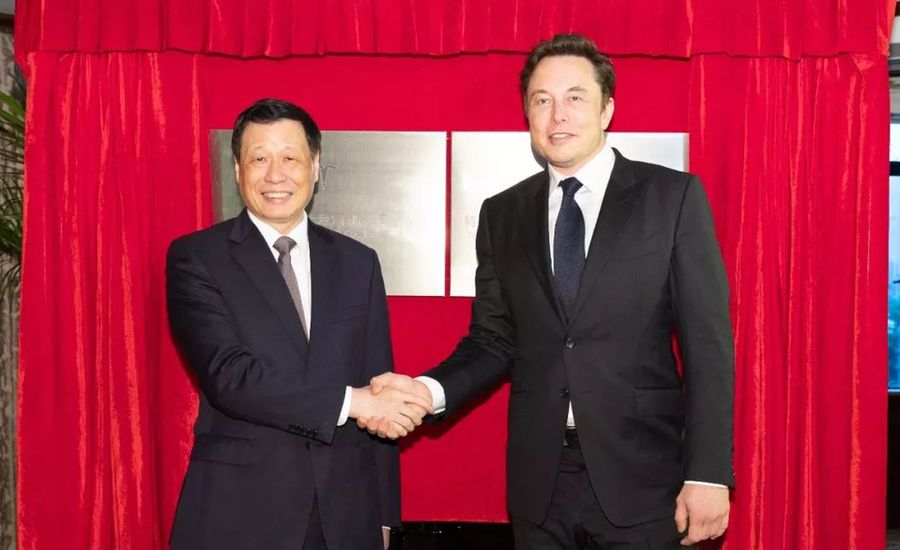
Tesla has signed an agreement with the government of Shanghai to open a plant in the Chinese city with the aim of building 500,000 of its electric vehicles there. Construction is expected to begin "in the near future, after we get all the necessary approvals and permits," a company spokesperson said in an email.
Once construction begins, it will take about two years until Tesla begins producing vehicles at the site, which it's calling Gigafactory 3. From there, it will be another two to three years before the factory hits its maximum capacity of 500,000 vehicles per year, the company said. In addition to manufacturing, Tesla will have research and development and sales operations at the site, located in the Lingang area of the city.
"Shanghai will be the location for the first Gigafactory outside the United States," CEO Elon Musk said in a Shanghai government release provided by Tesla. "It will be a state-of-the-art vehicle factory and a role model for sustainability," Musk added. "We hope it will be completed very soon. We've been impressed by the beauty and energy of Shanghai, and we want our factory to add to that."
Tesla recently increased its vehicle prices in China to more than 70 percent above U.S. levels, Reuters reported. The move, which other automakers have considered, was in reaction to China placing retaliatory tariffs on several U.S. goods, including autos. The vehicles built at Tesla's new plant will supply the China market. Musk has also said the company intends to build a Gigafactory in Europe, and eventually aims to have 10 to 12 Gigafactories worldwide.
In the U.S., Tesla has struggled to build its Model 3 at production sites in California and Nevada. Last week, the company said it had reached its long-sought but repeatedly missed goal of assembling 5000 units in a week, hitting 5031 total in the final seven days of the second quarter. The company said it expects to increase production of the Model 3 to 6000 units per week by late August. There were still about 420,000 unfilled Model 3 reservations at the end of the quarter; the company had delivered 28,386 Model 3s to date. It delivered a total of 40,740 vehicles in Q2, including 18,440 units of the Model 3, 10,930 of the Model S, and 11,370 of the Model X.
The company said Tuesday that the investment in China "will not impact our U.S. manufacturing operations, which continue to grow."
Auto tariffs likely to send used car prices higher, experts say
Prepare to pay more for your used car.
If the U.S. Commerce Department adopts President Donald Trump's proposal of a 25 percent tax on imported new cars and car parts, the higher costs for carmakers to assemble and sell new cars could boost demand for used vehicles, analysts predict.
"The parts would be the most affected for sure, assuming that the administration will put tariffs in place for parts as well," said Augusto Amorim, senior manager for Americas vehicle sales forecasts at LMC Automotive in Troy. "I don't think they'd consider any tariff on the used car at this point."
Automakers have warned their costs to build, and subsequently sell, new cars will rise. That's because every car assembled in the U.S. contains a large percentage of foreign parts, analysts said.
Toyota has said the costs of its cars could rise by thousands. General Motors last week said it would be forced to downsize and cut jobs.
Carmakers of course could choose absorb some of a 25 percent duty and not raise prices that much, said Maryann Keller, principal of Maryann Keller & Associates in the New York area.
"If a car doesn't have a lot of imported content, they might raise prices slightly and over time adjust it" depending on the imported parts in the vehicle.
For example, a Mercedes S-class sedan is fully imported, so a 25 percent duty on it would make it "incredibly expensive," Keller said. The 2018 S-class starts at $89,900.
"Would Mercedes raise the price on that car by 25 percent? I don't think so," she said. "They may decide it's more important to maintain sales. The more likely action would be a measured price increase across all models."
But even a nominal hike across all the models, Keller said, might be enough to push customers into the used market.
And if a new car is priced higher, its rate of depreciation is now starting at a higher point, said Keller. This will bump up prices on late-model used cars.
Secondly, there are the simple laws of supply and demand, said Ivan Drury, senior manager of industry analysis for Edmunds in Santa Monica, California.
"The used market could be injected with millions of consumers it never had before," Drury said. "It will cause a huge uptick in demand and we will see prices go up across the board for used cars."
The supply of used cars might be hit further if the U.S.-Canadian currency exchange rate suffers. Car dealers in Canada regularly send thousands of used cars to the U.S. to sell at auto auctions. It's lucrative for them because the U.S. dollar is stronger than Canadian currency. But that influx of used cars from Canada could freeze depending on what happens with tariffs, said Amorim.
"If the U.S were to impose this tariff, how Canada would retaliate and how that would impact the currency" isn't known, said Amorim. "We'd have to see the ratio between the U.S. dollar and the Canadian dollar and if that differs, we could see a higher or lower influx of used cars from Canada."
Likewise, if consumers can't afford new cars, new car sales will decline, reducing the number of trade-ins and making the used car supply tighter, said Jonathan Smoke, Chief Economist at Cox Automotive.
If 1 million customers switch to the used car market, the average transaction price could rise about 10 percent, said Drury. The average price of a used car is about $20,000, meaning it would go up by at least $2,000, he said.
Long thought to be less interested than previous generations in vehicle ownership and driving, most millennials actually like driving, according to a new survey from Hagerty. Survey results show that 81 per cent of participating millennial drivers say they like, love or are passionate about driving. This compares with 78 per cent of Gen X-ers and 79 per cent of baby boomers.
The survey was commissioned in response to the rapid rise of autonomous vehicle technology. Fifty-seven per cent of all respondents - including 64 per cent of millennials - believe a movement will be needed to preserve the driving experience when autonomous cars are the norm.
"Full autonomy is going to save lives, make commuting easier and unclog cities," said McKeel Hagerty, CEO of Hagerty. "But these survey results also indicate that people, including millennials, are always going to want to drive themselves when they want to. It's clear people don't want to lose the joy, freedom and control that comes with having their hands on the wheel."
Findings have prompted Hagerty to launch an initiative called "Why Driving Matters" to organize and amplify the voices of car lovers when it comes to future driving laws.
"One of our goals will be to work with policymakers so that years or even decades from now, when the bulk of cars are fully autonomous, the act of driving is protected," said Hagerty.
While electric and autonomous vehicles remain in development, Germany is pushing the envelope when it comes to futuristic tech: exploring the possibility of flying cars.
The German government signed a letter of intent with Audi and Airbus SE executives to "test air taxis" in and around Audi's hometown of Ingolstadt.
The Urban Air Mobility project was announced by Audi interim CEO Bram Schot, Federal Minister of Transport Andreas Scheuer, Airbus CTO Grazia Vittadini, Mayor of Ingolstadt Dr. Christian Lösel, and other representatives.
"We welcome the involvement of the city of Ingolstadt and support the development of the region as a test field for air taxis," said Schot.
The trial is intended to counter clogged city roads and "unlock new growth potential" for Germany's high-tech industry, the government's press office said in an emailed statement on Wednesday.
"We would like to use our know-how to improve urban life, and aim to develop new mobility concepts for cities and people's various needs with the Urban Air Mobility project," said Schot.
While flying cars may seem far off in the future, they could become a reality sooner than you think. At the Geneva Motor Show in March earlier this year, Audi, subsidiary Italdesign, and plane-maker Airbus SE unveiled their mobility concept: Pop.Up Next, an "an all-electric, fully automated concept for horizontal and vertical mobility."
Volocopter GmbH, a German startup backed by both Intel Corp. and Daimler, has built a "drone-like electric helicopter" that can ferry passengers across the city sky - and has already completed test flights. Volocopter GmbH hopes to offer the first commercial trips in the next three to five years.
"Flying taxis aren't a vision any longer, they can take us off into a new dimension of mobility," said Scheuer. "They're a huge opportunity for companies and young startups that already develop this technology very concretely and successfully."
Hyundai's next-generation NEXO fuel cell vehicle made its Canadian debut in Vancouver, B.C., during a ride-and-drive event that included the attendance of municipal and provincial government officials, according to the company's news release.
"Hyundai is the first automotive manufacturer to bring two generations of fuel cell vehicles to the Canadian market - first with the Tucson fuel cell, and now the all-new NEXO," said Don Romano, President and CEO of Hyundai Auto Canada. "The launch of NEXO reinforces Hyundai Motor Group's plan to bring 18 eco-friendly vehicles to global markets by 2025 to help pave the way for a greener future."
Elected officials were offered the chance to drive Hyundai's NEXO car and experience what it's like to sit behind the wheel of a fuel cell-powered vehicle. The carmaker also provided officials with information on how the technology can help contribute to a cleaner environment, as vehicles equipped with this feature run on hydrogen rather than gasoline.
"When Hydrogen and Oxygen are combined from the atmosphere into the fuel cell stack, electricity is produced via an electrochemical reaction," said Hyundai Auto Canada. "The only by-products of this process are water vapour and power, resulting in vehicles that yield zero-emissions."
Hyundai Auto Canada participated in the ride-and-drive event in collaboration with The Canadian Hydrogen Fuel Cell Electric Vehicle (FCEV) Coalition of automakers.